
.NET for the NES game console!

| metasprites ⬇️ | sprites ⬇️ |
 |
 |
| climber ⬇️ | horizscroll ⬇️ |
 |
 |
| rletitle ⬇️ | flicker ⬇️ |
 |
 |
| attributetable ⬇️ | statusbar ⬇️ |
 |
 |
See the samples/ folder for all 25 sample projects. Generate images with
dotnet run scripts/record-all-samples.cs.
PRs of any kind are welcome! If you have a question, feel free to:
Thanks!
Simply install the template:
dotnet new install dotnes.templatesCreate a project:
dotnet new nesOr use the project template in Visual Studio:

Build and run it as you would a console app:
dotnet runOf course, you can also just open the project in Visual Studio and hit F5.
Note that Ctrl+F5 currently works better in C# Dev Kit in VS Code.
Check out the video for a full demo:
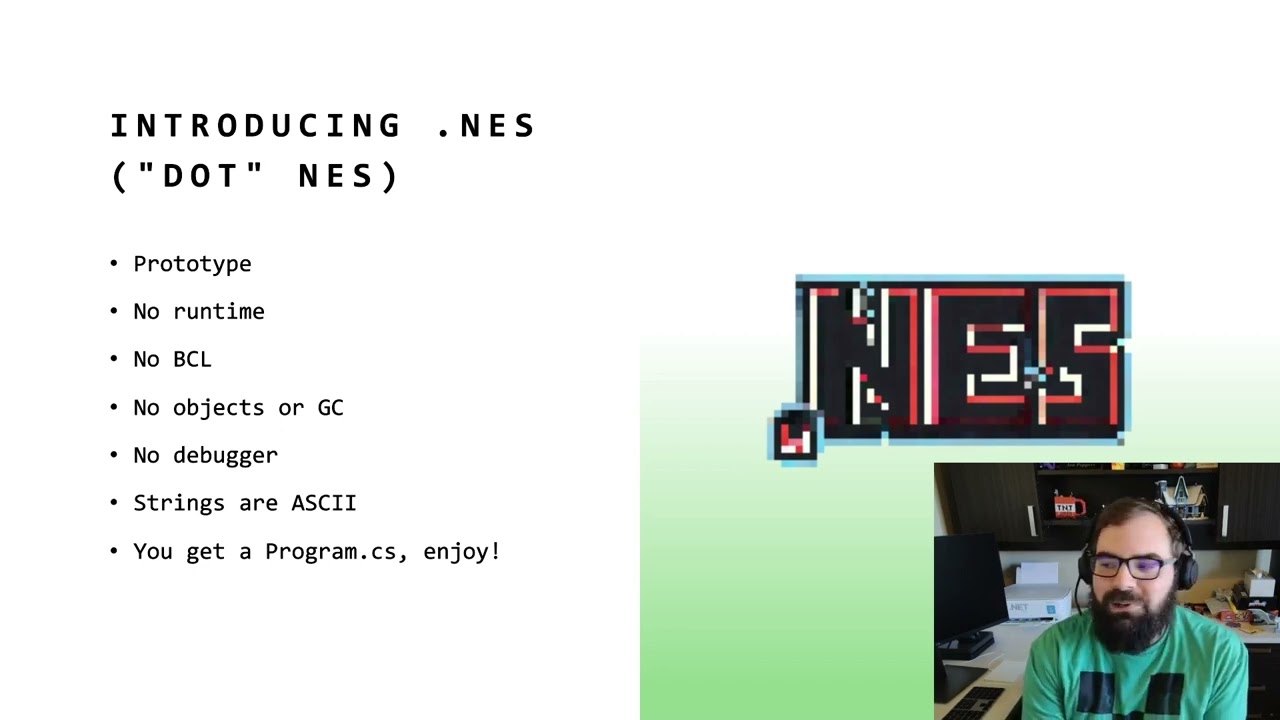
"Hello World" looks something like:
// set palette colors
pal_col(0, 0x02);   // set screen to dark blue
pal_col(1, 0x14);   // fuchsia
pal_col(2, 0x20);   // grey
pal_col(3, 0x30);   // white

// write text to name table
vram_adr(NTADR_A(2, 2));            // set address
vram_write("Hello, world!");         // write bytes to video RAM

// enable PPU rendering (turn on screen)
ppu_on_all();

// infinite loop
while (true) ;
This looks very much like "Hello World" in C, taking advantage of the latest C# features in 2023.
By default the APIs like pal_col, etc. are provided by an implicit
global using static NESLib; and all code is written within a single
Program.cs.
Additionally, a chr_generic.s file is included as your game's "artwork" (lol?):
.segment "CHARS"
.byte $00,$00,$00,$00,$00,$00,$00,$00
...
.byte $B4,$8C,$FC,$3C,$98,$C0,$00,$00
;;
This table of data is used to render sprites, text, etc.
.NES also supports NES music playback via the APU. The samples/music project
plays "The Easy Winners" by Scott Joplin using pulse and triangle channels:
ushort[] note_table = [ 4304, 4062, 3834, ... ];
set_music_pulse_table(note_table);

ushort[] tri_table = [ 2138, 2018, 1905, ... ];
set_music_triangle_table(tri_table);

byte[] music1 = [ 0x2a, 0x1e, 0x95, ... ];

apu_init();
start_music(music1);

while (true)
{
    ppu_wait_nmi();
    play_music();
}
For more details, see docs/music-sample.md.
The samples/metasprites project demonstrates runtime arrays, for loops, random
numbers, and metasprites — combining multiple hardware sprites into larger
sprites:
byte[] metasprite = [
    0, 0, 0xD8, 0,   // top-left
    0, 8, 0xD9, 0,   // bottom-left
    8, 0, 0xDA, 0,   // top-right
    8, 8, 0xDB, 0,   // bottom-right
    128               // terminator
];

byte[] actor_x = new byte[16];
byte[] actor_y = new byte[16];

byte i = 0;
while (i < 16)
{
    actor_x[i] = rand8();
    actor_y[i] = rand8();
    i = (byte)(i + 1);
}

while (true)
{
    byte oam_id = 0;
    i = 0;
    while (i < 16)
    {
        oam_id = oam_meta_spr(actor_x[i], actor_y[i], oam_id, metasprite);
        i = (byte)(i + 1);
    }
    if (oam_id != 0) oam_hide_rest(oam_id);
    ppu_wait_frame();
}The types of things I wanted to get working initially:
- An object model for writing NES binaries
- Building a project should produce a
*.nesbinary, that is byte-for-byte identical to a program written in C. - "Hello World" runs
- Byte arrays, and a more advanced sample like
attributetablerun - Local variables work in some form
- Project template, MSBuild support, IDE support
- Music playback via the NES APU (see
samples/music) - Metasprites, for loops, runtime arrays, and
rand8()(seesamples/metasprites)
Down the road, I might think about support for:
- Methods
- Structs
- Multiple files
- Some subset of useful BCL methods
For lack of a better word, .NES is a "transpiler" that takes MSIL and transforms it directly into a working 6502 microprocessor binary that can run in your favorite NES emulator. If you think about .NET's Just-In-Time (JIT) compiler or the various an Ahead-Of-Time (AOT) compilers, .NES is doing something similiar: taking MSIL and turning it into runnable machine code.
To understand further, let's look at the MSIL of a pal_col method call:
// pal_col((byte)0, (byte)2);
IL_0000: ldc.i4.0
IL_0001: ldc.i4.2
IL_0002: call void [neslib]NES.NESLib::pal_col(uint8, uint8)
In 6502 assembly, this would look something like:
A900          LDA #$00
20A285        JSR pusha
A902          LDA #$02
203E82        JSR _pal_col
You can see how one might envision using System.Reflection.Metadata to iterate over the contents of a .NET assembly and generate 6502 instructions -- that's how this whole idea was born!
Note that the method NESLib.pal_col() has no actual C# implementation. In
fact! there is only a reference assembly even shipped in .NES:
> 7z l dotnes.0.2.0-alpha.nupkg
   Date      Time    Attr         Size   Compressed  Name
------------------- ----- ------------ ------------  ------------------------
2023-09-14 14:37:38 .....         8192         3169  ref\net10.0\neslib.dll
If you decompile neslib.dll, no code is inside:
// Warning! This assembly is marked as a 'reference assembly', which means that it only contains metadata and no executable code.
// neslib, Version=0.1.0.0, Culture=neutral, PublicKeyToken=null
// NES.NESLib
public static void pal_col(byte index, byte color) => throw null;
When generating *.nes binaries, .NES simply does a lookup for pal_col to
"jump" to the appropriate subroutine to call it.
.NES also emits the assembly instructions for the actual pal_col subroutine.
The implementation uses an object model that represents 6502 instructions:
/*
* 823E	8517          	STA TEMP                      ; _pal_col
* 8240	209285        	JSR popa
* 8243	291F          	AND #$1F
* 8245	AA            	TAX
* 8246	A517          	LDA TEMP
* 8248	9DC001        	STA $01C0,x
* 824B	E607          	INC PAL_UPDATE
* 824D	60            	RTS
*/
// Uses Block and Instruction objects from the 6502 object model:
var block = new Block("_pal_col");
block.Emit(STA_zpg(TEMP))
     .Emit(JSR(popa))
     .Emit(AND(0x1F))
     .Emit(TAX())
     .Emit(LDA_zpg(TEMP))
     .Emit(STA_abs_X(PAL_BUF))
     .Emit(INC_zpg(PAL_UPDATE))
.Emit(RTS());This is a hobby project, so there are around 25 C# sample programs that are known to work. But to get an idea of what is not available:
- No runtime
- No BCL
- No objects or GC
- No debugger
- Strings are ASCII
What we do have is a way to express an NES program in a single Program.cs.
To learn more about NES development, I found the following useful:
I needed a simple, small NES emulator to redistribute with .NES that runs on Mac
and Windows. Special thanks to @daniel5151 and
ANESE. This is the default NES emulator
used in the dotnet.anese package, license
here.